
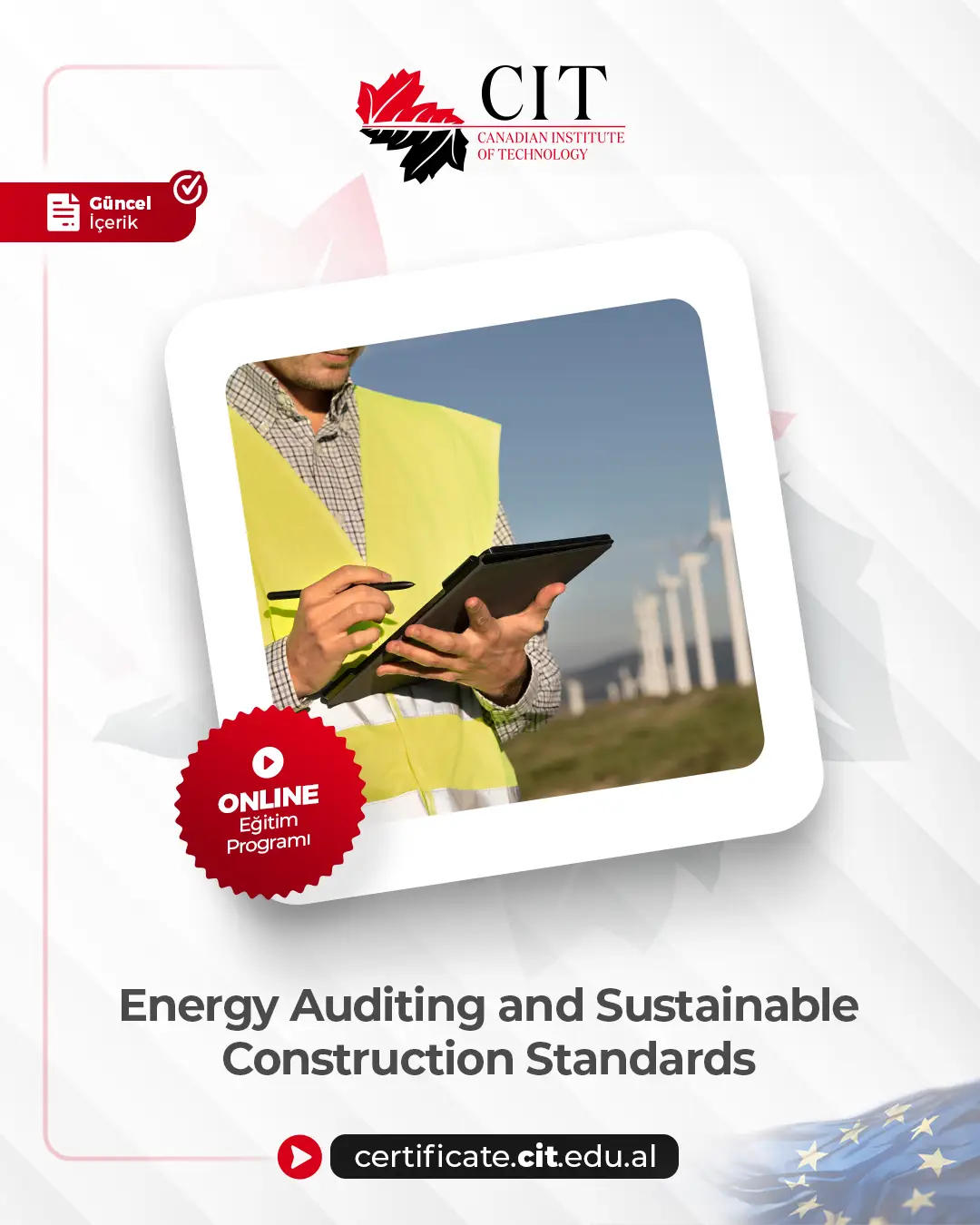
Energy Auditing and Sustainable Construction Standards
Description
Program summary
Format: Delivered online. If a specific program includes live sessions, an on-campus visit, or any in-person component, this will be clearly stated on the program page.
What you will gain:
• Plan and execute energy audits using a practical methodology
• Interpret energy data and convert findings into improvement actions
• Integrate sustainability criteria into project and operations workflows
• Prioritize interventions using cost–benefit and risk considerations
Who should attend:
Facility managers, energy managers, construction project teams, architects/engineers, and sustainability coordinators.
Course outline
1. Energy performance fundamentals and audit planning
2. Measurement & KPIs: consumption analysis and loss points
3. Audit reporting: findings, recommendations, action plans, follow-up
4. Sustainable construction standards: key criteria and implementation
5. Prioritization: ROI, feasibility, and risk-based scheduling
6. Case studies across different building types
Modules
10
What is included
Lessons
150
Review the module structure and lesson flow before enrollment.
Content sections
4
Review the sections below and open only the one you need. The summary panel on the side keeps the long explanation separate and readable.
Course Curriculum
Module roadmap
Review the module structure and lesson flow before enrollment.
Module 1
Foundations of Energy and Buildings
Module 2
Energy Auditing: Process and Methodology
Module 3
Building Services and Mechanical Systems
Next step
Add to Cart
You can add the product to your cart and proceed to the payment step.
Sample certificate
Preview the institution-issued certificate style learners can expect after successfully completing the program.

What is included
Course Curriculum
Review the module structure and lesson flow before enrollment.
Energy Fundamentals: Units, Forms and Conversion Principles
How Buildings Use Energy: Heating, Cooling, Lighting and Equipment
The Building Envelope: Walls, Roofs, Windows and Airtightness
Heat Transfer Principles: Conduction, Convection and Radiation
Thermal Mass and Its Role in Building Energy Performance
Moisture, Condensation and the Psychrometric Chart
Ventilation and Air Quality: Natural, Mechanical and Hybrid Systems
The Energy Balance of a Building: Gains, Losses and Net Demand
Climate and Microclimate: How Location Shapes Energy Demand
Introduction to Sustainable Construction: Principles and Priorities
Occupant Behaviour and Its Impact on Building Energy Use
Carbon Emissions from Buildings: Operational vs Embodied Carbon
The UK and EU Building Stock: Age, Typology and Retrofit Challenge
Setting Targets: Net Zero, Carbon Neutral and Energy Positive Buildings
Energy Poverty and the Social Dimensions of Building Performance
Energy Performance in Different Building Types: Residential, Commercial and Industrial
Building Physics in Practice: Case Studies in Heat, Air and Moisture
What Is an Energy Audit: Scope, Purpose and Types
ASHRAE Audit Levels: Walkthrough, General Survey and Investment Grade
Pre-Audit Preparation: Client Brief, Data Collection and Site Access
Utility Bill Analysis: Identifying Consumption Patterns and Anomalies
Energy Use Intensity: Benchmarking Against Sector Standards
On-Site Walkthrough: Systematic Inspection Techniques and Checklists
Interviewing Building Occupants and Facilities Managers
Metering and Sub-Metering: Understanding Where Energy Goes
Energy Monitoring Equipment: Data Loggers, Sensors and Meters
Load Profiling: Mapping Energy Demand Against Time and Activity
Identifying Energy Conservation Measures: Prioritisation Framework
Cost-Benefit Analysis of Energy Measures: Payback and NPV
The Audit Report: Structure, Content and Presentation Standards
Presenting Findings to Clients: Communication and Persuasion Skills
Post-Audit Follow-Up and Implementation Support
Advanced Data Analysis Techniques for Energy Auditors
Heating Systems: Boilers, Heat Pumps and District Heating
Cooling Systems: Chillers, Air Handling Units and Refrigerants
HVAC Controls: Thermostats, BMS and Programmable Logic
Domestic Hot Water Systems: Storage, Instantaneous and Solar Thermal
Ventilation Systems: Fans, Ductwork and Heat Recovery
Compressed Air Systems: Efficiency, Leakage and Pressure Optimisation
Pumps and Motors: Variable Speed Drives and System Efficiency
Lighting Systems: Lamp Types, Controls and Daylight Integration
Building Management Systems: Architecture, Functions and Optimisation
Metered Data Analysis for Building Services
Commissioning and Re-Commissioning of Building Services
Predictive and Preventive Maintenance for Energy Performance
Industrial Process Energy: Steam, Compressed Air and Heat Recovery
Refrigeration Systems: Cold Storage, Retail and Industrial Applications
Heat Interface Units and Communal Heating Systems
U-Values and Thermal Transmittance: Calculation and Measurement
Insulation Materials: Properties, Applications and Installation
Thermal Bridging: Identification, Impact and Mitigation
Airtightness Testing: Blower Door Tests and Pressure Diagnostics
Infrared Thermography: Principles, Equipment and Interpretation
Window and Glazing Performance: G-Values, U-Values and Shading
Roof and Loft Insulation: Strategies for New and Existing Buildings
Wall Insulation: Cavity, Internal and External Systems
Floor Insulation and Ground Heat Losses
Retrofit Sequencing: Getting the Order of Measures Right
Damp, Mould and Indoor Air Quality After Retrofit
Heritage and Listed Buildings: Retrofit Without Compromising Character
Measuring Thermal Performance: Pre and Post-Retrofit Verification
Ground Investigation and Foundation Thermal Performance
Acoustic and Thermal Performance Trade-Offs in Retrofit
Solar Photovoltaics: How They Work, Sizing and Grid Connection
Solar Thermal: Flat Plate, Evacuated Tube and System Design
Heat Pumps: Air Source, Ground Source and Water Source Systems
Biomass and Bioenergy: Fuels, Systems and Sustainability
Wind Energy: Small-Scale Turbines, Siting and Output Estimation
Combined Heat and Power: Principles, Feasibility and Economics
Battery Storage: Technologies, Sizing and Grid Interaction
Hydrogen as an Energy Carrier: Current Status and Future Role
District Energy Networks: Heat and Cooling Networks
Microgrids and Decentralised Energy Systems
Feasibility Assessment for Renewable Energy Integration
Integrating Renewables into Building Energy Audits
Smart Controls and Demand-Side Response for Low Carbon Buildings
EV Charging Infrastructure and Building Energy Integration
Power Purchase Agreements and Corporate Renewable Energy
BREEAM: Framework, Categories and Assessment Process
LEED: Structure, Credit System and Certification Levels
WELL Building Standard: Health, Wellbeing and Productivity
Passivhaus: Principles, Criteria and Certification
NABERS and International Rating Systems Overview
EPC and SAP: Methodology, Outputs and Regulatory Role
Part L and Building Regulations: Compliance and Notional Buildings
Nearly Zero Energy Buildings: EU Directive and National Plans
Net Zero Carbon Buildings: Definitions, Pathways and Verification
Embodied Carbon: Measurement, Standards and Reduction Strategies
Whole Life Carbon Assessment: Framework and Methodology
Green Infrastructure and Biodiversity Net Gain in Construction
Circular Economy Principles in Construction and Retrofit
Sustainable Materials: Selection, Specification and Procurement
BREEAM and LEED for Retrofit: Applying Standards to Existing Buildings
Green Building Certification in Practice: Common Pitfalls and How to Avoid Them
Life Cycle Costing: Principles and Application to Energy Measures
Simple Payback and Return on Investment for Energy Projects
Net Present Value and Internal Rate of Return in Energy Auditing
Sensitivity Analysis: Accounting for Uncertainty in Energy Projects
Energy Performance Contracting and the ESCO Model
Green Finance: Grants, Loans, Green Bonds and Tax Incentives
Carbon Pricing and Its Impact on Energy Investment Decisions
Procurement Routes for Energy Efficiency Projects
Risk Assessment and Management in Energy Retrofit Projects
Building the Business Case: Presenting Energy Investments to Stakeholders
Social Return on Investment in Energy Efficiency Programmes
Value Engineering in Energy Projects: Optimising Measures and Costs
Funding Landscape for UK Domestic Retrofit: ECO4, HUG and GBIS
Introduction to Building Energy Modelling: Tools and Applications
Dynamic Simulation Modelling: EnergyPlus, IES and DesignBuilder
Simplified Calculation Methods: RdSAP, SBEM and DECoRuM
Defining the Baseline: Establishing Pre-Retrofit Energy Performance
Modelling Interventions: Predicting Energy Savings Accurately
Calibrating Models to Measured Data: Reducing the Performance Gap
Sensitivity Analysis in Energy Models
The Performance Gap: Why Buildings Underperform and What to Do
Measurement and Verification: IPMVP Options and Protocols
Post-Occupancy Evaluation: Closing the Feedback Loop
BIM and Digital Twins for Energy Management
Energy Management Systems: ISO 50001 Implementation
UK and EU Climate Policy: Net Zero Targets and Building Sector Obligations
The Energy Efficiency Directive: Requirements and Implications
EPCs in Policy: Minimum Energy Efficiency Standards and Rental Compliance
Planning Policy and Sustainable Construction Requirements
The Future Homes Standard and Building Regulation Reforms
Professional Bodies: CIBSE, RICS, IEMA and the Energy Institute
Energy Auditor Qualifications: Routes, Standards and CPD
Legal Liability and Professional Indemnity in Energy Auditing
Client Management and Report Communication Skills
Ethics and Conflicts of Interest in Energy Consulting
Health and Safety on Energy Auditing Site Visits
Tendering and Winning Energy Audit Contracts
Building Your Energy Auditing Practice: Business Development
Quality Assurance and Peer Review in Energy Consultancy
Carbon Reporting and Scope 1, 2 and 3 Emissions for Buildings
Net Zero Strategy Development for Organisations and Building Portfolios
Domestic Energy Audit Case Study: End-to-End Worked Example
Commercial Office Audit Case Study: Multi-Storey Office Building
Retail Energy Audit Case Study: Supermarket and Shopping Centre
Industrial Energy Audit Case Study: Manufacturing and Process Energy
Social Housing Retrofit: Scale, Funding and Quality Assurance
School and University Buildings: Energy Audit Considerations
Healthcare Buildings: Hospitals, Clinics and Energy Compliance
Smart Buildings and IoT: Energy Data Analytics and Automation
Future Skills in Energy Auditing: AI, Digital Twins and Machine Learning
Net Zero Retrofit Strategy: Whole-House and Whole-Building Approach
Community Energy Projects: Local Energy Planning and Co-operatives
International Energy Auditing: Standards and Practice Beyond the UK
Voluntary Disclosure and Green Claims: Avoiding Greenwashing
Continuing Professional Development and the Energy Auditor of the Future
Course Conclusion: Your Role in the Net Zero Transition
Program details
Content sections
Review the sections below and open only the one you need. The summary panel on the side keeps the long explanation separate and readable.