
Data Engineering and Analytics for AI
Description
Program summary
Format: The program is delivered online. If there are live sessions, campus visits, or in-person components, they are clearly specified on the program page.
What will you gain from this training?
• Designing a data lifecycle for AI projects
• Data quality and governance approach (control points, traceability)
• Building scalable systems with ETL/ELT and pipeline thinking
• Establishing analytical metric models and reporting logic
Who should attend?
Data engineers/analysts, AI teams, technical product managers, and teams building data platforms.
Modules
10
What is included
Lessons
149
Review the module structure and lesson flow before enrollment.
Content sections
4
Review the sections below and open only the one you need. The summary panel on the side keeps the long explanation separate and readable.
Course Curriculum
Module roadmap
Review the module structure and lesson flow before enrollment.
Module 1
Module 1 — Fundamentals and Ecosystem Overview
Module 2
Module 2 — Data Collection and Ingestion Systems
Module 3
Module 3 — Data Storage and Architecture
Next step
Add to Cart
You can add the product to your cart and proceed to the payment step.
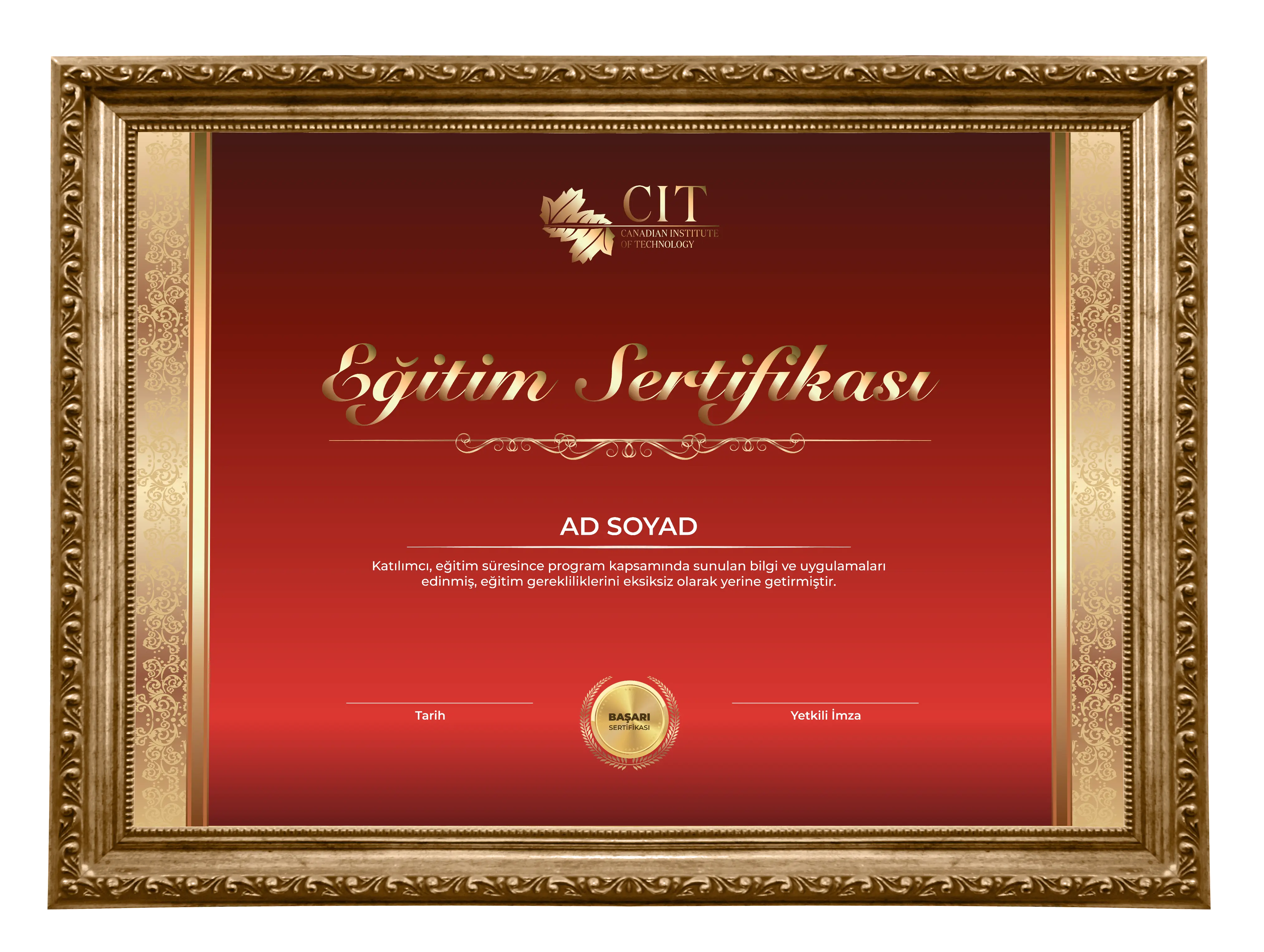
Sample certificate
Preview the institution-issued certificate style learners can expect after successfully completing the program.
What is included
Course Curriculum
Review the module structure and lesson flow before enrollment.
The intersection of artificial intelligence and data engineering
Data engineer vs. data scientist vs. ML engineer roles
What is the Modern Data Stack
Data maturity model: from raw data to AI
What is batch processing and how it works
What is stream processing and how it works
Batch vs. streaming: differences and use cases
Cloud platforms: AWS, GCP, and Azure data services overview
Overview of core tools used in data engineering
Data source taxonomy: structured, semi-structured, and unstructured data
What is a REST API and how data ingestion works
API authentication methods: API keys, OAuth, and JWT
Pagination and rate limiting concepts
Web scraping fundamentals and HTML structure
What is Change Data Capture (CDC) and how it works
Apache Kafka architecture: topics, partitions, and brokers
How Kafka producers and consumers work
Source and sink integration with Kafka Connect
Offset management and at-least-once semantics in Kafka
Message queue systems: RabbitMQ vs. Amazon SQS
File formats: CSV, JSON, Parquet, Avro, and ORC
Data compression methods and serialization concepts
Schema evolution: managing schema changes over time
What is a Data Warehouse and its historical evolution
Kimball vs. Inmon architectural approaches
Star schema and snowflake schema design
What is a Data Lake and why it emerged
Layered data architecture: Bronze, Silver, and Gold
What is a Data Lakehouse: Delta Lake and Apache Iceberg
Columnar storage and its impact on query performance
Partitioning strategies: why and how
Clustering and indexing: speeding up large tables
Snowflake architecture: virtual warehouses and storage separation
BigQuery architecture: how serverless analytics works
Object storage: S3, GCS, and Azure Blob concepts
NoSQL database types and use case scenarios
What is a vector database and how it works
Pinecone, Weaviate, and Chroma comparison
What is a feature store and why it matters
Time-series databases and storing timestamped data
What is ETL: Extract, Transform, Load explained
What is ELT and its role in the modern data stack
ETL vs. ELT: which approach to use and when
Apache Spark architecture: driver, executor, cluster manager
What is an RDD and how it differs from DataFrame and Dataset
Lazy evaluation and execution plans in Spark
Join types and the cost of shuffle operations in Spark
Spark performance optimization: caching and broadcast joins
Spark Streaming: micro-batch and continuous processing
What is dbt and the SQL-based transformation approach
dbt model layers: staging, intermediate, and mart
dbt ref() function and dependency management
dbt tests and automated documentation
Apache Flink and event-time stream processing
Watermarks and handling late-arriving data
What is DuckDB: in-process analytical SQL
Slowly Changing Dimensions (SCD) types 1, 2, and 3
Data normalization and denormalization concepts
Dimensions of data quality: accuracy, completeness, consistency, timeliness
Data profiling: statistical analysis and anomaly detection
Data validation concepts and rule-based checks
The Great Expectations framework and the expectation concept
Data dictionary and metadata management
What is a data catalog: DataHub and Amundsen
Data lineage: tracing data from source to destination
GDPR and data privacy regulations for data engineering
Data masking and anonymization techniques
Data encryption: security in transit and at rest
What is Master Data Management (MDM)
Data mesh architecture: domain ownership and data as a product
Data contracts concept and implementation
What is workflow orchestration and why it is needed
Apache Airflow architecture: scheduler, worker, metadata database
The DAG concept: how to define dependency graphs
Airflow operator types: Python, Bash, and Sensor
Error handling in Airflow: retries, alerts, and SLAs
Modern workflow design philosophy with Prefect
Dagster: the asset-centric orchestration philosophy
Experiment tracking with MLflow: runs, metrics, and artifacts
MLflow model registry and version management
CI/CD for data: automated testing and deployment concepts
Infrastructure as Code: managing data infrastructure with Terraform
What is Kubernetes and why it matters for data workloads
Model deployment approaches: REST API, batch, and streaming
Model monitoring: performance degradation and data drift
The difference between concept drift and data drift
Why feature engineering matters: its impact on models
Numerical features: scaling and normalization techniques
Binning and discretization techniques
Categorical features: one-hot, label, and target encoding
How to handle high-cardinality categorical variables
Extracting meaning from date and time features
Feature extraction from text data: TF-IDF and n-grams
Missing data analysis: types and imputation methods
Outlier detection: IQR, Z-score, and isolation forest
Feature selection: filter, wrapper, and embedded methods
Dimensionality reduction: PCA concept and geometric intuition
Dimensionality reduction and visualization with t-SNE and UMAP
What is an embedding: from words to vectors
Word2Vec, GloVe, and FastText embedding models
Sharing and reusing features with a feature store
Real-time feature computation and online serving
LLM training data requirements: quantity, diversity, and quality
Pre-training data: Common Crawl and web-scale corpora
Text cleaning pipeline: deduplication, filtering, and normalization
What is tokenization: BPE and WordPiece algorithms
The impact of tokenization on model performance
Instruction tuning data: format and quality criteria
What is RLHF: learning from human feedback
Collecting preference data and annotation guidelines
What is RAG architecture: retrieval-augmented generation
Document chunking strategies: size and overlap
Embedding model selection and evaluation criteria
Vector indexing algorithms: HNSW and IVF
Hybrid search: combining dense and sparse retrieval
What is re-ranking and two-stage retrieval
Synthetic data generation: augmenting data with LLMs
Preparing and quality-checking fine-tuning datasets
Evaluating LLM outputs: metrics and benchmarks
Analytics maturity levels: from descriptive to prescriptive
Descriptive analytics: answering what happened
Diagnostic analytics: answering why it happened
Predictive analytics: answering what will happen
Prescriptive analytics: answering what should we do
SQL window functions: RANK, LAG, LEAD, PARTITION BY
How to perform cohort analysis with SQL
Retention and churn analysis concepts
Funnel analysis: measuring conversion pipelines
A/B testing: statistical significance and p-values
KPI selection and metric design principles
Dashboard design principles: simplicity and hierarchy
Data visualization fundamentals with Tableau
Building reports and dashboards with Power BI
Business intelligence architecture with Looker and LookML
Real-time metric monitoring with Grafana
Data storytelling: the art of communicating findings effectively
Lambda architecture: batch layer and speed layer
Kappa architecture: can a single stream solve everything
Comparing Lambda and Kappa architectures
Scalability principles in big data architecture
Choosing a data platform: build vs. buy decision
Cost optimization: reducing cloud spending
Data security: access control and role-based authorization
Data replication and backup strategies
Multi-cloud and hybrid cloud data architectures
Real-time analytics architecture: OLAP and HTAP
The future of data engineering: AI-native data stack
Industry use cases: finance, healthcare, and e-commerce
Data engineering career path and learning resources
Program details
Content sections
Review the sections below and open only the one you need. The summary panel on the side keeps the long explanation separate and readable.